
10 March 2026
How to Choose the Right Safety Net for Your Balcony
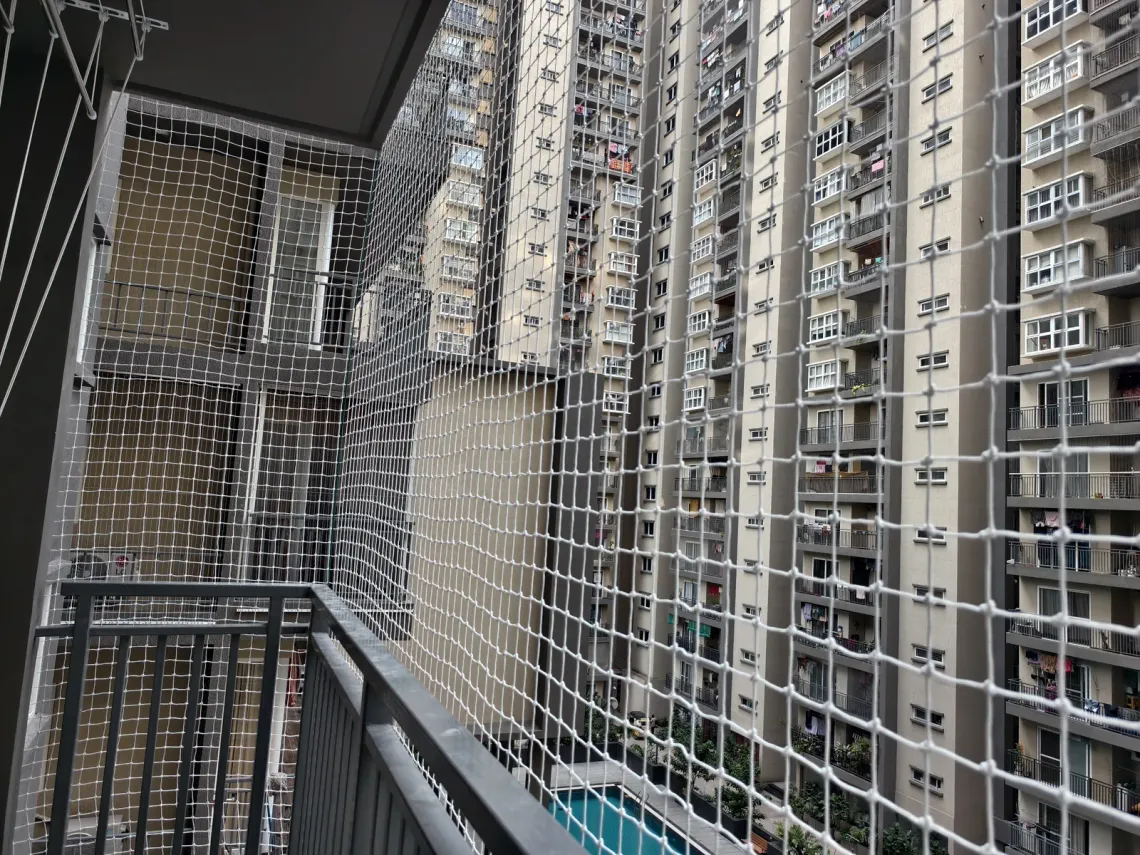
If you’re comparing options for your balcony, terrace or staircase, a few practical factors matter far more than price alone. Here’s what to actually check before choosing a safety net.
1. Material: HDPE vs Nylon
Most safety nets sold in India are made from either high-density polyethylene (HDPE) or nylon. HDPE nets are UV-stabilised, which matters a lot in a city like Chennai where balconies get direct sun for most of the year — untreated nylon can degrade and weaken faster under constant UV exposure. Always ask whether the net is UV-stabilised before buying.
2. Mesh Size
Mesh size is usually measured in inches (like 2” x 2”) and determines what the net can stop. A tighter mesh (smaller squares) is better for homes with toddlers, pets, or in areas with heavy pigeon activity, since it also blocks smaller gaps. A looser mesh is lighter and cheaper but only suitable for basic fall protection where small-gap coverage isn’t a concern.
3. Load Capacity and Knotting
A net is only as strong as its knots. Look for knotted nets rather than knotless/woven ones for balcony safety applications — knotted construction holds its shape under sustained load and doesn’t unravel if a strand is damaged. Ask for the rope thickness (usually 2mm–4mm) and whether the net has been load-tested.
4. Anchoring and Hardware
Even a strong net is only as good as what it’s tied to. Rust-proof hooks, stainless steel anchors, and proper spacing between anchor points (typically every 12–18 inches) prevent sagging over time. In coastal cities like Chennai, avoid plain mild-steel hardware — it corrodes quickly in humid, salty air.
5. Installation Without Damage
Good installers can fit most balcony nets using existing grill structures or minimal drilling, avoiding unnecessary damage to walls or window frames. If a quote involves extensive drilling for a standard balcony, it’s worth asking why.
A Quick Checklist Before You Buy
- Is the material UV-stabilised HDPE?
- Is the mesh size appropriate for your use case (kids, pets, birds)?
- Is the net knotted, not just woven?
- What’s the rope/anchor hardware made of?
- Does the installer offer a free site visit to assess your specific balcony?
Colour, Visibility and Appearance
Safety nets come in white, black, green and transparent finishes. A darker net tends to blend into the background when seen from inside, while a white net can look brighter and more visible. There is no single correct choice: pick the one that suits your building and your view. What matters more is the tension of the net, because a slack net looks untidy and offers less protection.
Ask About Warranty and After-Sales Support
A good installer stands behind the work. Ask what is covered, for how long, and who to call if a section loosens after a storm. A written quote that lists the material, mesh size, and installation scope helps you compare offers fairly. Be cautious of quotes that are very low compared with others, since they often use thinner cord or fewer fixing points.
Match the Net to the Space
A balcony with children needs tighter mesh and higher coverage than a terrace used mainly to keep birds away. A staircase opening needs strong edge fixing, since people may lean on it. Explain your main concern clearly, whether it is child safety, pets, pigeons or general protection, and the installer can recommend accordingly.
Plan for Maintenance
Nets are low-maintenance, but not maintenance-free. Wipe off dust, check the corners after strong wind, and replace any damaged section promptly. Doing this once or twice a year extends the life of the installation and keeps it looking neat.
If you’d like a free site visit to figure out the right net for your balcony in Chennai, get in touch with our team or browse our Safety Nets service page for more details.